
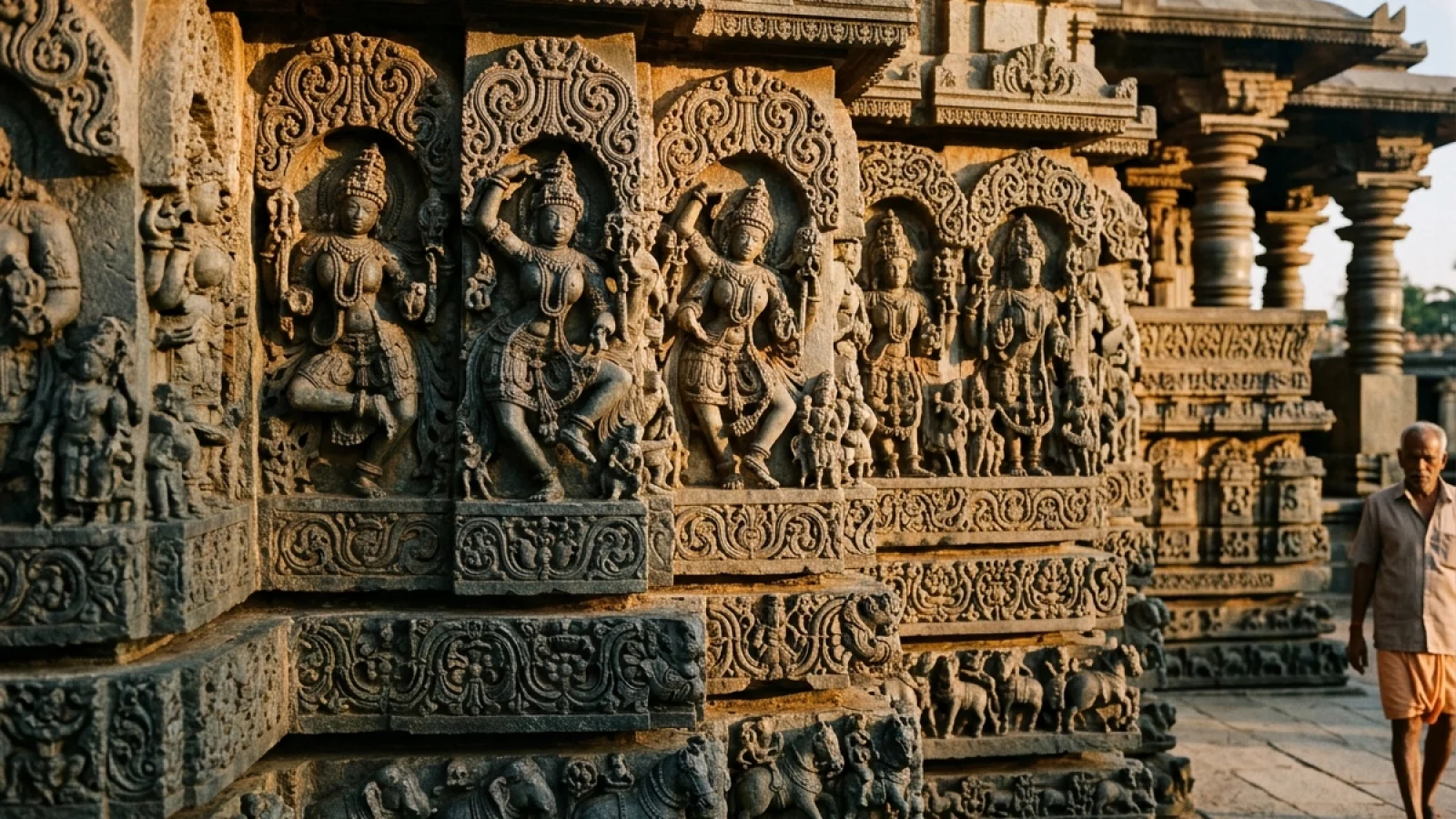
### How to walk the exterior star-shaped platform The Chennakeshava complex was commissioned by King Vishnuvardhana in 1117 CE to mark the Hoysala victory over the Cholas. Built from chloritic schist (soapstone)—a rock that is soft when quarried and hardens upon exposure to air—it allowed medieval sculptors to achieve detail closer to ivory carving than conventional stonework. Walk the elevated star-shaped platform (*jagati*) in a clockwise direction (*pradakshina*). As you circumambulate, read the horizontal base friezes from bottom to top: * **Tier 1 (The Base):** 650 marching elephants, symbolising stability and cosmic strength. Notice that each elephant displays distinct harness details, ear tilts, and gait. * **Tier 2:** Charging lions (*shardulas*), symbolising royal courage. * **Tier 3:** Scrolling foliage and floral arabesques (*patralata*), signifying living abundance. * **Tier 4:** Continuous miniature equine cavalrymen. * **Tier 5:** Another scroll border depicting scenes from the Mahabharata, Ramayana, and Bhagavata Purana. ### The 38 Madanika Brackets Look upward beneath the eaves: thirty-eight bracket figures (*shilabhalikas* or *madanikas*) depict women engaged in music, martial arts, astrology, and grooming. Notice the *Darpana Sundari* (the maiden looking into a hand mirror) and the *Tribhangi* dancer whose ornaments are completely undercut from the stone slab.
Heritage Site
Belur, Hassan District, Karnataka
Hoysala Stone Friezes of Belur
A visual reading guide to the 12th-century Chennakeshava Temple: decoding chloritic schist stone friezes, celestial bracket figures, and the horizontal narrative bands.
When
Year-round; early morning (07:30–09:30 AM) offers optimal diagonal sunlight across the eastern friezes.
How
38 km from Hassan Railway Station; accessible by road from Bengaluru (220 km, 4.5 hours via NH75).
Who
Archaeological Survey of India accredited guides stationed near the Raja Gopura entrance ticket counter.
What to see
The star-shaped platform (jagati), the 650-elephant frieze where no two beasts share a pose, and 38 bracket Madanikas.
Accessibility
The outer perimeter platform requires climbing five broad stone steps; temple sanctum interior is dimly lit and barefoot.
Geographic Coordinates
13.1623° N, 75.8596° E · Belur, Hassan District, Karnataka
Filed under:
Heritage sites