When you stand before a medieval stone temple in peninsular India—whether Hoysala, Chola, or Chalukya—the sheer density of carving can feel overwhelming. Hundreds of deities, animals, musicians, and mythical beasts jostle along every moulding. Tourists walk past them with cameras, seeing only ornament.
To the medieval visitor, however, the temple wall was not decoration. It was a rigorous, highly legible text—a three-dimensional manuscript designed to be read in a specific direction and from ground to sky.
The rule of pradakshina (clockwise circulation)
Every temple is oriented to be read during pradakshina, the ritual clockwise circumambulation. If you walk counter-clockwise, the visual narrative runs backwards. When following the sun:
-
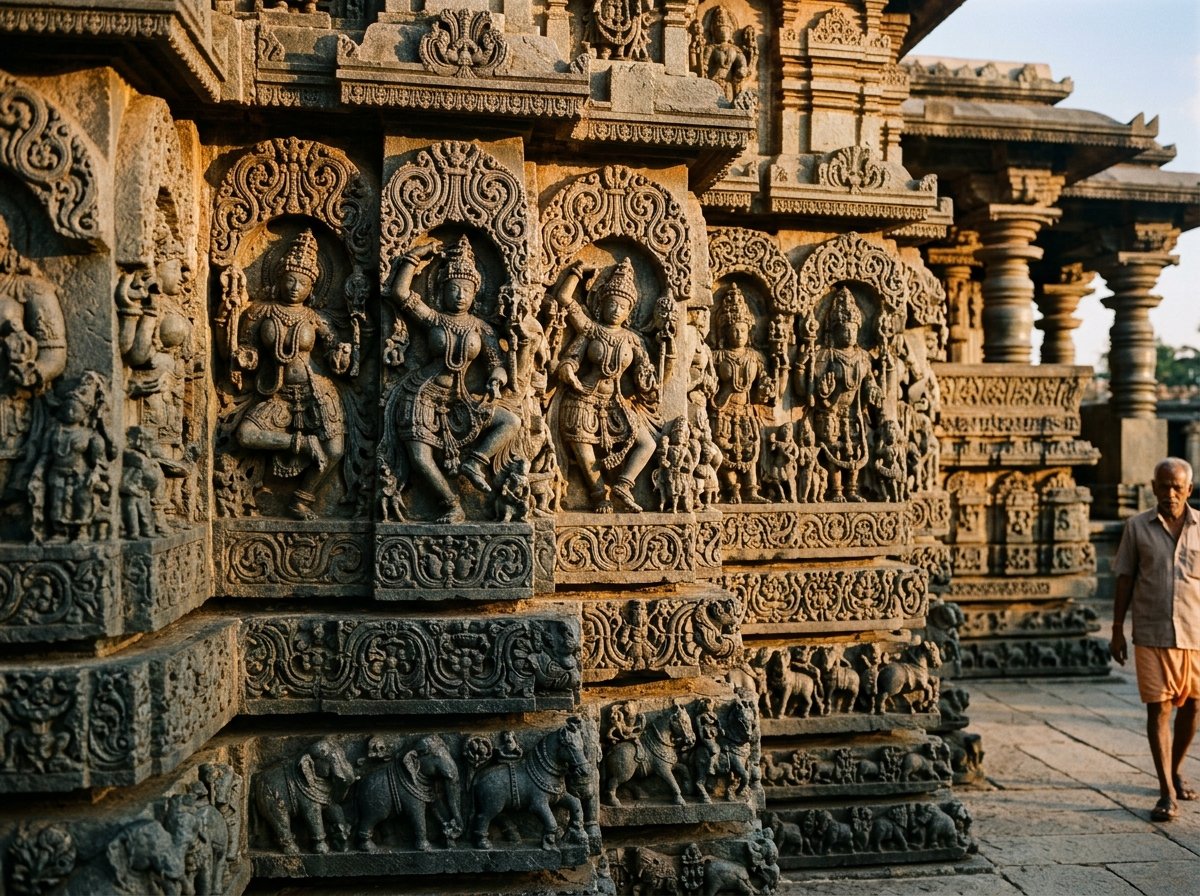
The plinth bands (Adhishthana): At the very bottom, ground level meets the earth. Look closely at the horizontal tiers:
- The lowest band is almost always elephants—representing weight, stability, and carrying the earth.
- Above them run lions or shardulas—representing strength, courage, and royal majesty.
- Next come horses—signifying swiftness and martial vitality.
- Above the horses is a frieze of floral creepers (latapatra)—signifying fertility and living vegetation.
- Above the creepers are miniature narrative bands depicting scenes from the epics (Ramayana, Mahabharata, and Puranas).
-
The middle register (Jangha): Here the miniature friezes give way to life-sized celestial figures. This is the realm between earth and heaven: apsaras, shalabhanjikas (bracket figures embracing flowering trees), guardians (dvarapalas), and divine manifestations. Note their postures (tribhanga, the three-bend grace) and hand gestures (mudras).
-
The superstructure (Shikhara / Vimana): As the eye moves upward toward the spire, individual identities dissolve into rhythmic repeating architectural modules (kutas and shalas), converging upon the pinnacle (kalasha) where form returns to the formless.
How to spot the sculptors' signatures
In many Hoysala monuments—unlike the anonymous cathedral masters of medieval Europe—the master sculptors carved their signatures proudly beneath their figures. Look for miniature inscriptions in Old Kannada at the pedestal base: names like Mallitamma, Dasoja, and Chavana. They were the celebrated artists of their day, commissioned across royal dynasties.
Next time you stand before a temple wall, do not look at everything at once. Begin at the northwest corner, locate the lowest elephant frieze, and read upward and clockwise. The stone reveals its rhythm.